Good Morning, SleepyLand!
And sometimes, that’s worse than doing the wrong thing.
TL;DR
In this episode:
- The anatomy of apathy broken down into spreadsheets.
- Event weights, flags, and variables that quietly judge your every move.
- Systems that track you longer than your memory does.
- Designing consequences that feel accidental, but aren’t.

Apathy feeds on the belief that nothing changes, no matter what you do, so we designed against it.
In SleepyLand, every choice shifts the world:
- Small actions ripple.
- Passive decisions stack.
- Consequences hide, accumulate, and wait.
The player may not notice, but the system does.
1. An eventful system (where random isn't random)
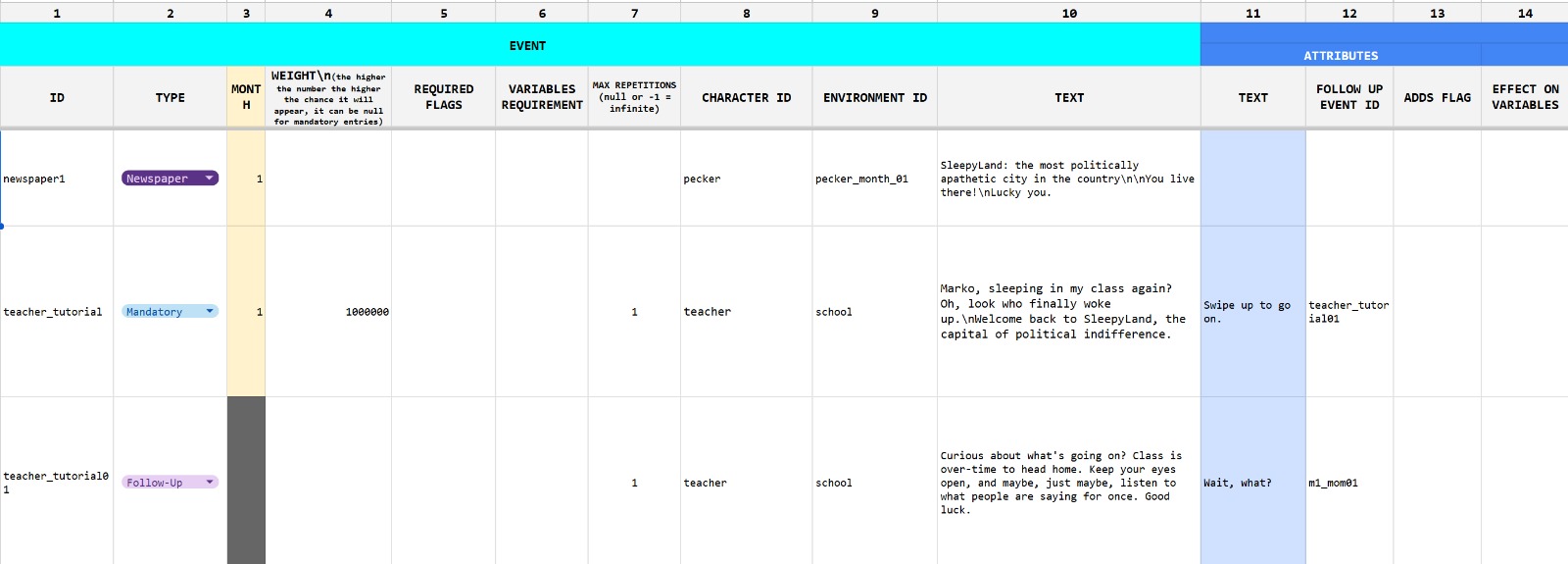
To create a dynamic and responsive world, we structured the game’s narrative events using a flexible system that allowed for randomized encounters while preserving key story moments.
Each event was categorized based on its role in the overall narrative structure:
- Newspaper events:
- Uninteractive events that present major world developments.
- Players cannot interact with anything else while they are active.
- Serve to reinforce the evolving state of the world based on the player’s actions.
- Mandatory events:
- Core story beats that must be experienced before progressing to the next phase of the game.
- Even with randomized elements, each month’s progression is gated by these events to ensure coherence.
- Follow-up events:
- Triggered by specific player choices from previous events.
- Ensure that decisions carry consequences beyond immediate feedback.
- Standard events:
- Randomized encounters that enrich the world but are not essential for progression.
- Can be missed depending on event weighting and player choices.
- Salary events:
- Monthly triggers that appear if the player has a job, reflecting the economic aspect of the game world.
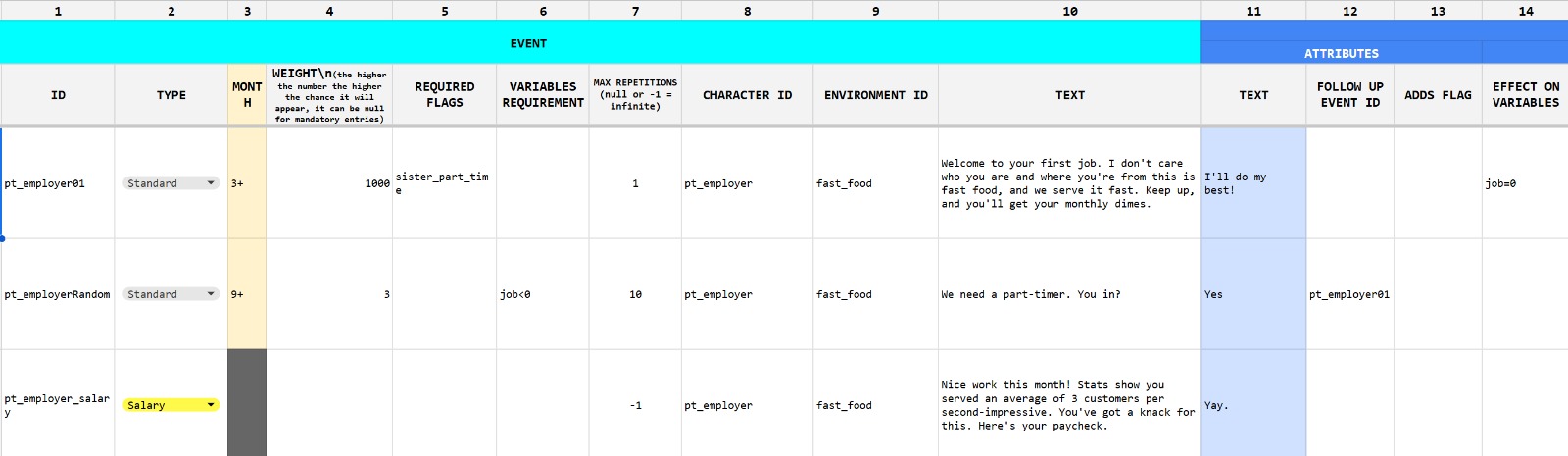
Each event is linked to a specific timeframe, defined as:
- A single month (e.g., “3”)
- A range of months (e.g., “3-5”)
- A starting point that lasts until the end of the game (e.g., “3+”)
Additionally, every event has a weighting system, to balance between frequent and rare occurrences.
2. Flags gossiping behind your back
Events do not exist in isolation, they are deeply tied to game mechanics through a structured system of flags, variables, and progression dependencies.
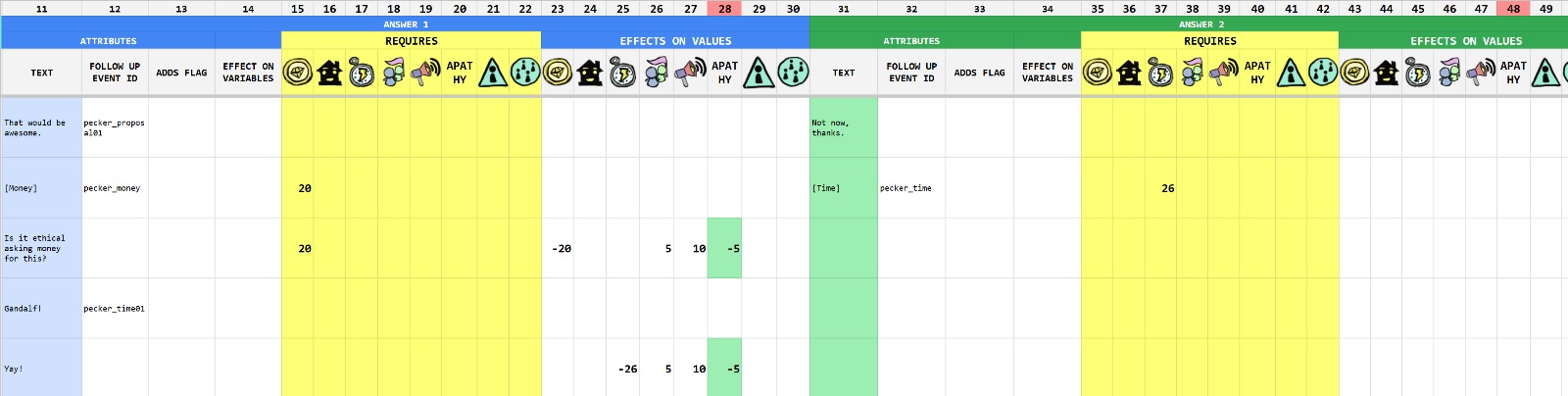
Each event entry contains:
- Event ID → A unique identifier for tracking.
- Triggers and Requirements → Events only appear if specific conditions are met, determined by:
- Flags (binary states tracking key decisions)
- Variables (numeric values affecting gameplay, e.g., “supporters > 30”)
- Character & Environment IDs → Dictate which avatar and background appear, as well as their associated SFX.
The game world evolves dynamically as events modify the game state:
- New flags and variables are introduced through narrative progression.
- Stats exist outside the event system but the events can interact with them.
- New variables can be dynamically added via the event system without external implementation, allowing for seamless expansions.
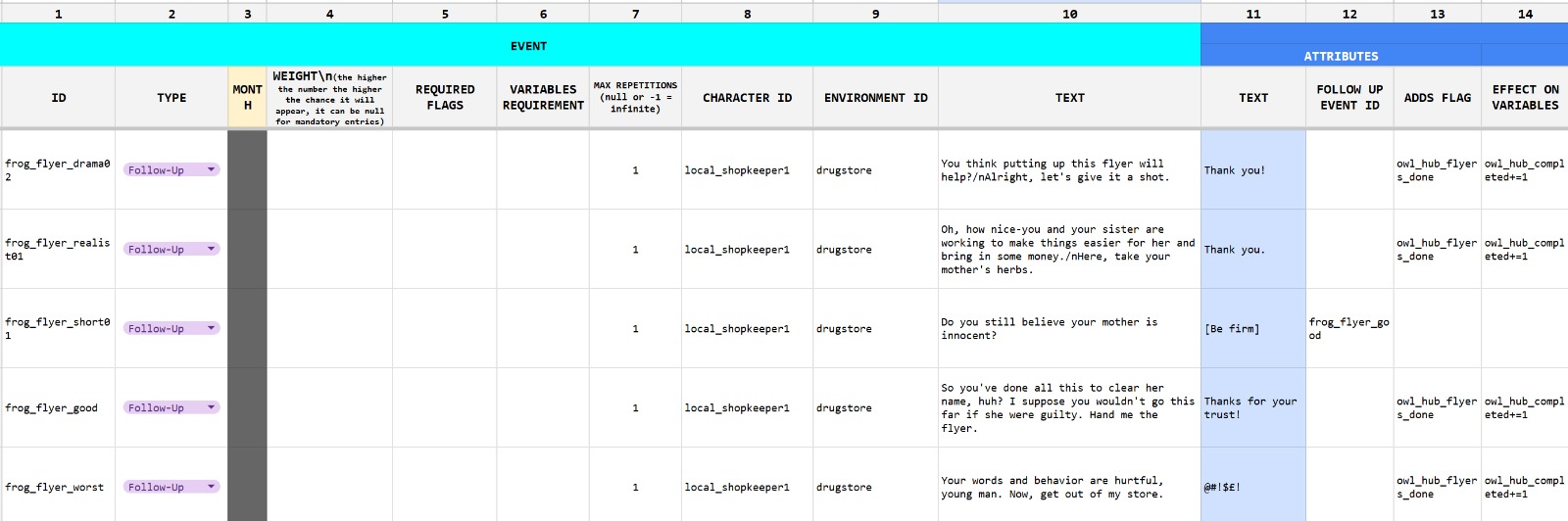
Each event presents the player with 1 to 4 choices, structured as follows:
- Answer text → The dialogue or action option presented to the player.
- Follow-up event ID → Determines if the choice triggers a new, predefined event.
- Flags added → Updates the game state based on the choice.
- Variable effects → Alters numerical stats (e.g., increasing “media coverage” or decreasing “political apathy”).
3. Locked choices and regret
Some choices are locked behind requirements: if the player lacks certain stats or flags, they can’t be selected.
Unlike missing events (which never appear if requirements aren’t met), locked choices remain visible but greyed-out, reinforcing the impact of past decisions.
This serves two key functions:
- Encouraging strategic play – players can see what they’re missing, shaping long-term decision-making.
- Reinforcing thematic weight – forces players to accept consequences, rather than always picking an optimal path.
4. What you see vs. what bites you later
We designed a dual-layered choice system that controlled what the player could predict and what remained hidden:
Visible Effects (Strategic Play)
When the player drags an answer card, they preview how it will affect their stats before committing.
This allows for calculated decision-making, reinforcing the game’s resource management mechanics.
Hidden Effects (Thematic Play)
Some choices come with no preview of what they’ll change — only the requirements to unlock them are visible.
Once chosen, the consequences are locked in.
These hidden outcomes are designed for moments of emotional weight: irreversible decisions, moral dilemmas, or turning points where players must act on instinct, not strategy.
They keep the experience grounded in story, not system mastery.
5. There’s no narrative layer (it’s all system)
Rather than being an isolated storytelling layer, the narrative is woven into the game’s core mechanics through:
- Persistent event tracking → the game continuously updates flags and variables, ensuring long-term consequences.
- Dynamic game state updates → new variables can be introduced at any time without additional implementation.
- Multi-layered narrative design → choices impact both immediate feedback (dialogue, minor stat changes) and long-term consequences (world events, character arcs).
The key stats controlled by the narrative system are:
- Player’s family wealth
- Family’s health and happiness
- Player’s available time
- Political supporters
- Media coverage
- Town’s political apathy
- Individualistic vs collective mindset points.